How an Elder’s Simple Truth Helped Me Reconnect With My Teenage Daughter After Two Years of Silence

If you have a teenage daughter who used to tell you everything — and now tells you nothing — read every word on this page.
If she used to run to your room just to sit beside you. And now she barely looks up when you enter hers.
If you have noticed that the laughter is gone. The little jokes. The “Mummy, guess what?” moments. All of it — gone.
If you are lying in bed at night wondering what you did wrong. Replaying conversations. Searching for the moment it all changed.
If you have tried talking to her and she gives you one-word answers. You ask about school. She says “fine.” You ask about her friends. She says “they’re okay.” And then silence settles like a fog between the two of you.
If you have read parenting books. Watched YouTube videos. Maybe even joined a Facebook group for mothers. And still nothing has worked.
If you have tried being softer. And she still pulled away. You tried being firmer. And she pulled further. You gave her space. The space became a wall.
If you have started to feel like a stranger in your own relationship with your own child.
If you wake up and the first thought is: Is today the day she talks to me again? And by night you are exhausted from carrying the answer: no.
The real pain is not the silence. You can survive silence.
The real pain is watching her laugh freely with her friends. Seeing her open up on the phone. Knowing she has words — beautiful, warm words — and none of them are for you.
The real pain is the fear underneath it all. That you are losing her. That by the time she is grown and gone, you will be two polite strangers who share a last name.
I know. Because I carried that fear too. For two years. I carried it quietly, alone, smiling at the school gate while my chest was hollow.

My name is Mama J.
I am not a child psychologist. Not a counsellor. Not a parenting expert with a certificate on the wall.
I am just a mother who spent two years inside this problem — and found a way through it.
I am from Ibadan. I married young, moved to Lagos, raised my children in a compound where noise was love and food was language.
My daughter, Temi, was eleven when I first noticed it. Small things. She stopped telling me about her friends. She stopped sitting beside me while I cooked. She stopped laughing at my jokes — which, fine, maybe my jokes were always bad. But she used to laugh anyway.
By the time she was thirteen, we were living parallel lives inside the same apartment. She was not rude. She was not rebellious in the way people warn you about. She was just… absent. Present in the body. Gone everywhere else.
I spent money I did not have. I bought books — three parenting books, two of them still unfinished on my shelf. I signed us up for a mother-daughter event at church. She sat beside me, smiled politely, and said nothing the whole drive home.
I tried to have “the talk.” Not once. Many times. Each time she looked at me with eyes that said: I love you, Mummy. But I do not want to do this. And I did not know what “this” was. That was the part that destroyed me. I did not even know what I was doing wrong.
I talked to my sister. She said: “Give her time, she will come back.” I talked to my friend Bunmi. She said the same thing. Give her time.
But two years passed. And the distance did not close. It just became familiar. And familiar distance is the most dangerous kind — because you stop fighting it. You start accepting it as normal.
What hurt most was not even the silence between us.
It was the version of me I was becoming. The mother who knocked on her own daughter’s door and waited — like a guest — to be let in.
The Day Everything Changed
My cousin’s naming ceremony was held in Abeokuta. A big family gathering — the kind where three generations share one compound, where the smell of egusi and jollof rice fills every room, where the elders sit in the best chairs and watch the young ones with eyes that see everything.
Temi came with me reluctantly. She sat in the corner with her phone for the first two hours. I said nothing. I had stopped saying things.
I spent the afternoon greeting relatives, carrying plates, pretending everything was fine. The way you do at family events. You perform okayness. You smile when someone says “Ah, your daughter is so big now!” and you say “Yes o, time flies” while inside you are praying they do not ask if you are close.
There was an elder there. A woman named Iya Agba Folasade. She was my great-aunt’s closest friend — a woman in her late seventies, small and sharp-eyed, the kind of elder who does not miss a thing. She had raised seven children in the same compound, married off four daughters, and was known in the family for saying exactly what she saw.
I did not know she was watching me.
I did not know she was watching Temi either.
Late in the afternoon, as the gathering wound down and people began to leave, I saw Iya Agba Folasade look from Temi to me. Then back to Temi. Then to me again.
Something shifted in her face. Not pity. Recognition.
“Come, let me talk to you.”
She called me away from the others. We sat together on a low bench near the back of the compound where the noise could not reach us. She took my hand. She looked at me for a long moment without saying anything.
And then she said the words I had been waiting two years to hear.
“You have not lost her. She is just waiting to feel safe.”
I did not cry gracefully. I did not dab my eyes like they do in films. I shook. The kind of crying that embarrasses you — the kind that says I have been holding this for a very long time.
She held my hand and waited.
When I could breathe again, she spoke.
We did not have all this, in our time. But when our daughters pulled away, we knew one thing — it was never about words. It was never about what you say. It was about the ground she is standing on when you say it.”
I sat with that for a moment. The ground she is standing on.
Here is what Iya Agba Folasade helped me understand. And it changed everything.
Your daughter’s brain has an emotional safety system. When that system works well, she runs to you. She tells you things. She trusts you with her fears and her hopes and the things she is embarrassed about. Because you are safe.
But when that system is repeatedly signalled — even in small ways — that this space is not safe for her full self, it adapts. It learns. It begins routing her emotions elsewhere. To friends. To her phone. To silence. The brain is not being difficult. It is doing exactly what it was designed to do.
This is what I now call the Emotional Safety Gap. The space between who she is and who she feels she can be around you. Every mother-daughter pair that has drifted has this gap. And the problem is not love — you both love each other. The problem is that the gap has never been deliberately closed.
I sat with that for a long time.
I thought about how much money I had spent. How many books I had read. How many conversations I had tried to force. How many times I had interpreted her silence as a rejection of me — when all along it was a protection of herself.
It took one woman, on a low bench in a quiet compound in Abeokuta, to tell me what was actually happening.
And then she told me what to do about it.
She described a method. Simple. No confrontation. No big emotional conversation. No forcing of anything. A series of small, daily actions — most of them taking less than five minutes — that slowly signal to a teenager’s emotional brain: this is a safe place. You are not in danger here. You can come back.
There is no special tool. Nothing you need to buy from a shop. Everything is done at home. With your hands and your presence and your patience.
The First Few Days: Nothing
Day one. I went home and started.
Nothing happened.
Day two. I followed the method exactly as Iya Agba Folasade had described.
Nothing happened.
Day three. Temi came downstairs, passed through the living room, said “Good morning,” and went to the kitchen. Exactly as she always did.
Day four. I almost stopped. I remember standing in the corridor thinking: This is not working. She cannot even tell anything is different. And then I remembered what the elder had said. Do not skip the early days because nothing seems to be happening.
So I continued.
Day 5: The First Sign
It was a Thursday evening.
I was sitting in the living room when Temi came downstairs — not for anything specific, just to sit. She did not say much. But she sat near me. Not across the room. Near me.
It was a small thing. You would not even notice it if you were not watching for it. But I had been watching for it for two years. I kept my face calm. I did not say anything about it. I just kept watching TV.
Inside, I was shaking.
Day 6. Day 7. Then Something Broke Open.
Day six — she asked me about something she was cooking. A small question. But she asked me.
Day seven — she laughed at something I said. A real laugh. Not the polite one. The one that comes from the belly without asking permission first.
Day eight — she told me about a friend. Just briefly. Just two sentences. But she told me. Unprompted. Voluntarily. She turned to me and said the words and I listened and she kept going and I did not interrupt and she kept going a little more and then she stopped and smiled a small smile and went upstairs.
Day nine — I realised I had not checked in the morning.
For two years, my first thought every morning was: Will she talk to me today? On day nine, I woke up and made tea and started the day and I only realised, somewhere around 9am, that I had not done the check. The anxious morning inventory. The bracing for another day of distance.
I had simply… forgotten to brace.
For someone who had been bracing every single morning for twenty-four months — forgetting to brace was the proof. That is still the part that gets me, even now.
But the real test was yet to come.
A Saturday Morning, About Two Weeks In
I was in the kitchen. It was a Saturday. I was frying eggs, not thinking about anything in particular.
Temi walked in.
She did not want food. She did not need anything. She just leaned against the counter near me and started talking. About a film she had watched. About a girl in her class who had done something funny. About a song she had discovered.
She talked for twenty-three minutes. I counted, later.
I did not cook much of that food properly. I was too busy being completely still, the way you are when a bird lands on your hand and you do not want to move a single muscle in case it flies away.
When she finally drifted off to her room, I turned off the stove and stood in the kitchen for a long time.
Then I sat down on the kitchen floor and cried.
Not from sadness. From the particular, overwhelming relief of something returning that you had been afraid was gone forever.
She came back talking about a film. She did not know she was ending two years of my grief. She was just talking. And I was just receiving her. That was enough.
I Didn’t Plan to Tell Anyone
I told one friend. My friend Chisom, in Enugu. I sent her a voice note — just to share, not to advise. I had not planned to give anyone instructions or a method. I just wanted to tell someone.
Chisom listened. Then she called me back.
“Mama J. This is exactly what is happening in my house.”
Her daughter was fifteen. Had been distant for about a year. Different story on the surface, same gap underneath.
I walked her through what the elder had told me. She tried it. Three weeks later she sent me a voice note that was mostly just her crying.
Then Chisom told someone. That someone told someone else. Phone calls started coming — women I barely knew, women I had not spoken to in years. All of them with the same story wearing different faces. A daughter who had gone quiet. A mother who did not know what she had done wrong. A gap that had grown so familiar they had stopped trying to close it.
Same method. Same approach. Same results.
Same method. Same ingredients. Same approach. Same results.
Why I Am Sharing This
After about the tenth phone call from a mother I did not know, I went back to Abeokuta. I visited Iya Agba Folasade at her home. I sat with her and told her everything — about Chisom, about the other women, about the voice notes.
She listened without expression. When I finished, she laughed. One of those long, knowing laughs that only very old women can produce.
I asked her if I could write it all down. Document it properly. Make it available to mothers who could not come and sit with her on a bench in Abeokuta.
She was quiet for a moment.
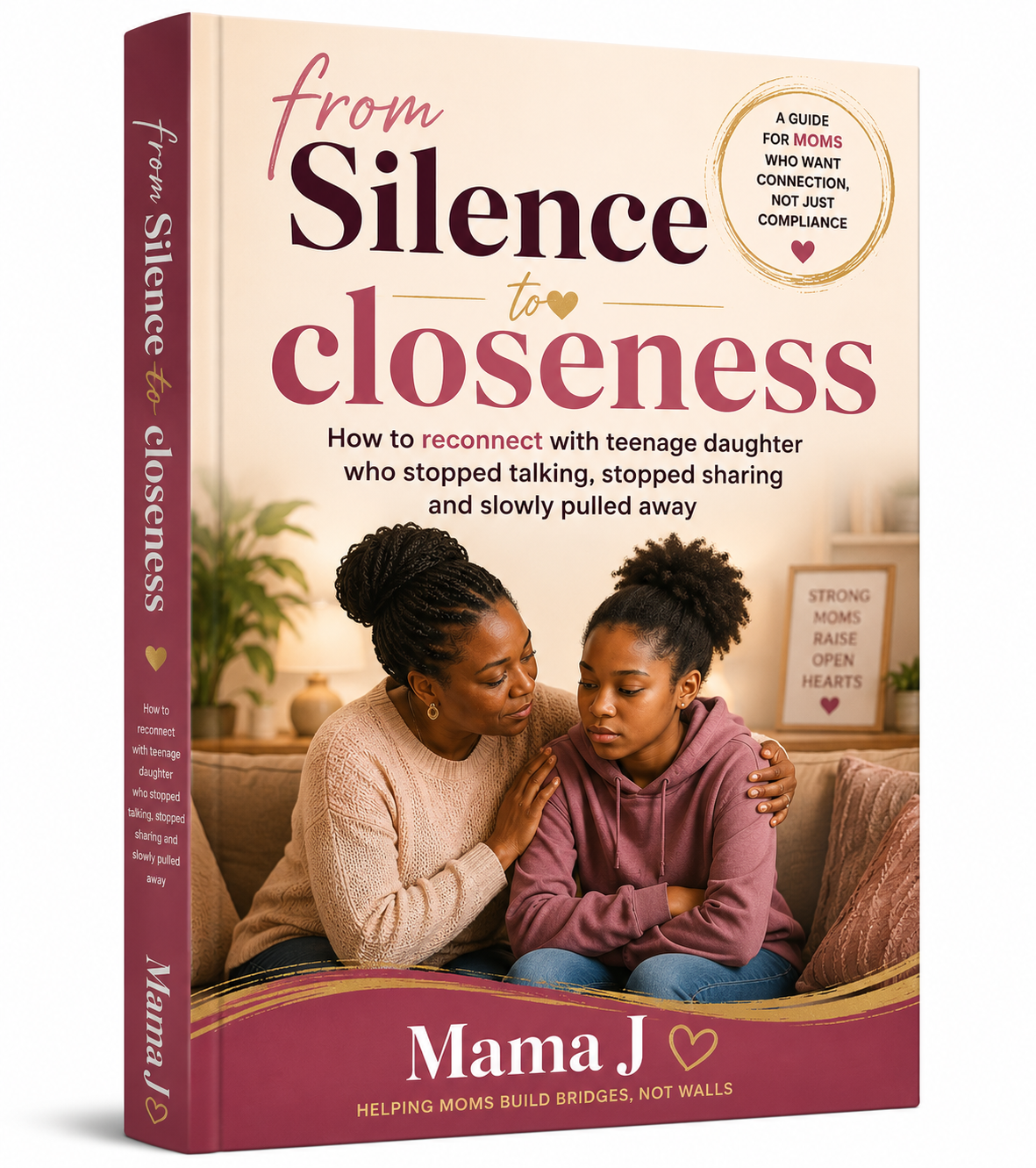
Everything Iya Agba Folasade taught me — documented, verified, written in plain everyday language, so you can begin tonight. No qualifications needed. No confrontations. No big dramatic conversations. Just a clear, step-by-step path back to your daughter.
- The Emotional Safety Gap Method (Full Protocol) — The exact sequence of daily actions that signals safety to your daughter’s emotional brain, step by step. (Pages 8–21)
- Why She Pulled Away — The Real Reason — A plain explanation of what actually happens inside a teenager’s mind when she starts to emotionally withdraw. Not theory. Practical understanding that changes how you respond. (Pages 4–7)
- The 7 Things That Widen the Gap Without You Knowing — Specific behaviours that most loving mothers do daily that signal “not safe” to a teenage girl. Including the #1 mistake that undoes everything else you try. (Page 22–26)
- What to Say and What Never to Say — Word-for-word examples of responses that open her up versus responses that shut her down. Based on real conversations, not textbook scripts. (Pages 27–33)
- The Re-entry Window — How to Reconnect Without Making It Awkward — The specific low-pressure approach to beginning the method when things feel stiff and strange between you. (Pages 34–38)
- The Monthly Maintenance Ritual — What to continue doing after she comes back, so the connection grows instead of fading again. (Pages 39–42)
- The Extended Protocol — For Severe Distance — A longer 21-day track for daughters who have been distant for two years or more, or where there has been conflict or hurt. (Pages 43–50)
- The Father/Household Factor — How the overall home environment affects your daughter’s emotional safety, and small adjustments that support your work. (Pages 51–54)
You do not need to travel anywhere. You do not need special training. Everything described in this guide can be done in your own home, in your own time. Total cost of materials? Nothing. Everything required is already in you.
Compare That to What You Have Already Been Spending
- ✗ Parenting books — ₦4,000–₦12,000 each. Most are written by Western psychologists about Western families. You read half of one and feel guilty for the rest of the day. Nothing changes at home.
- ✗ Church counselling sessions — ₦5,000–₦20,000 per session. Helpful for spiritual support. But you go home to the same silence. The counsellor does not live in your house.
- ✗ Online parenting courses — ₦15,000–₦50,000. Hours of video content. Generic advice. Not designed for Nigerian mothers. Not designed for the specific pain of a daughter who has already pulled away.
- ✗ Family therapy — ₦20,000–₦80,000 per session. Difficult to get a teenager to agree to. And what happens in the therapy room does not always survive the car ride home.
- ✗ Waiting it out — “free.” Except that every month you wait, the gap becomes more normal. The walls become higher. And your daughter practices being far from you until it is the only way she knows how to be.
- The real cost — the one nobody puts a number on — is the years. The Saturday mornings. The school runs. The evenings when she was home and you were both right there and still completely apart. That time does not come back.
How Much Does This Guide Cost?
Let me show you what went into creating it.
- Research, interviews with mothers, and documentation — ₦45,000
- Professional writing and editing — ₦35,000
- Design and formatting — ₦18,000
- Testing with real mothers and daughters over 6 months — Priceless. But also a lot of chin chin and prayer.
- Platform and delivery setup — ₦12,000
A fair price would be ₦15,000. I would not be embarrassed to charge that.
But I know times are hard. School fees are landing. The market is what it is. And I did not do this to get rich. I did this because Iya Agba Folasade told me to make sure every mother who needs it can reach it.
So if you take action today —
Once You Click That Button, Here Is What Happens
- You are taken to a secure payment page. Pay safely with your card, transfer, or USSD.
- Your payment is confirmed instantly.
- Your complete guide — plus all bonuses — is delivered to your WhatsApp number AND your email address within 60 to 90 seconds.
It is me, Mama J. As long as your payment is confirmed, your access is 100% guaranteed. No delays. No runaround.
What Happens in the First 7–14 Days
Real conversations. Real women. Real results.
WAIT — I Have Something Special For You…
If you are one of the first 75 women to secure your copy today, you also receive this bonus — completely free:
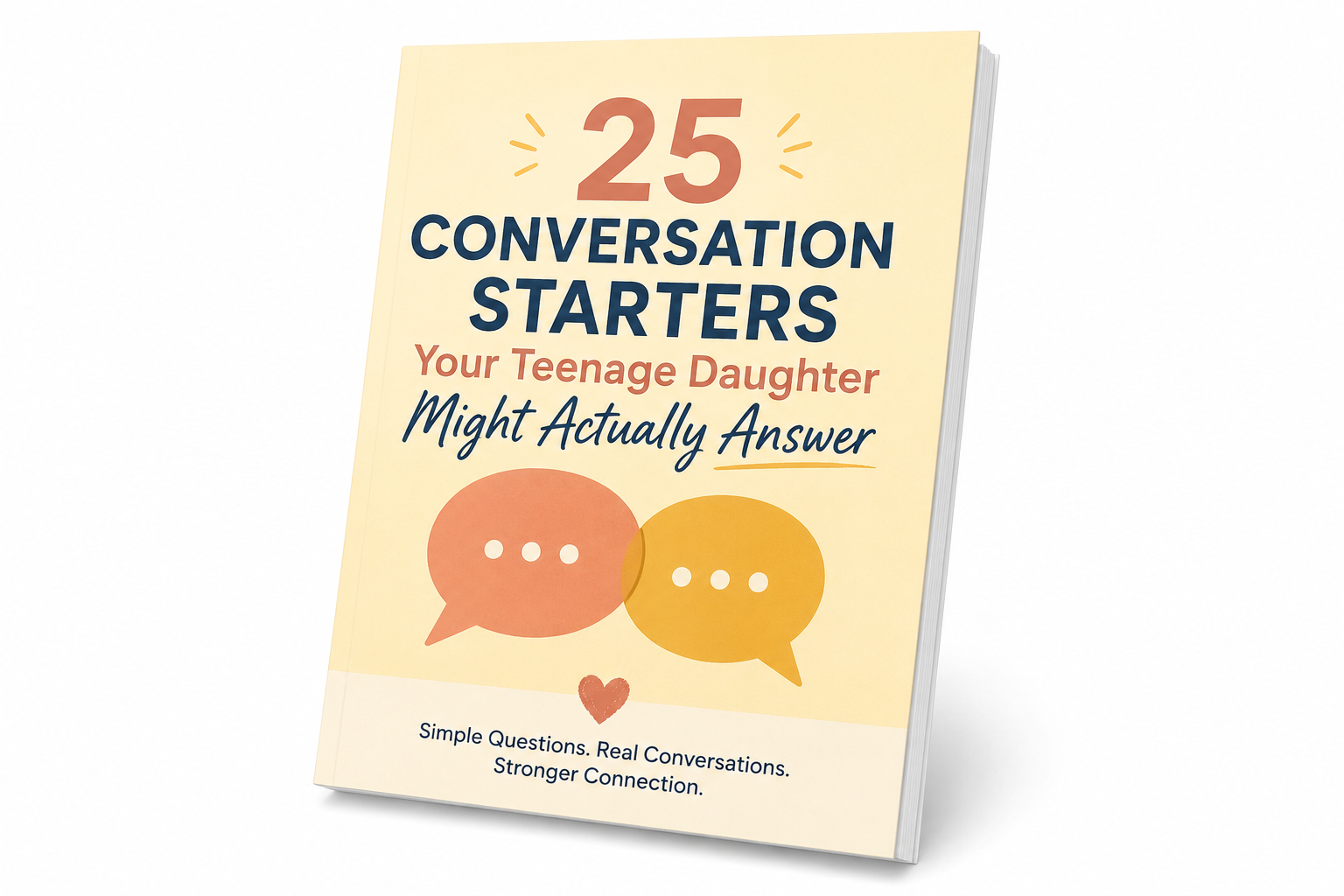
Let’s be honest. Many conversations between mothers and teenage daughters die after three words: “How was school?” “Fine.” The problem is not always the question. It is that most questions feel repetitive, predictable, or pressure-filled.
These 25 conversation starters are designed to feel lighter, safer, and genuinely engaging — organised by purpose:
- Fun questions — to make her laugh and ease the atmosphere
- Connection-building questions — to help her feel truly seen and understood
- Future-focused questions — to invite her to dream out loud in your presence
- Lighthearted questions — for the ordinary moments that become the memories
- Questions to AVOID — specific phrases that create defensiveness no matter how well-intentioned
You do not have to use them all at once. Pick one. Ask it naturally. Let her answer. The goal is connection — not interrogation.
“Curiosity invites conversation. Judgment usually ends it.”
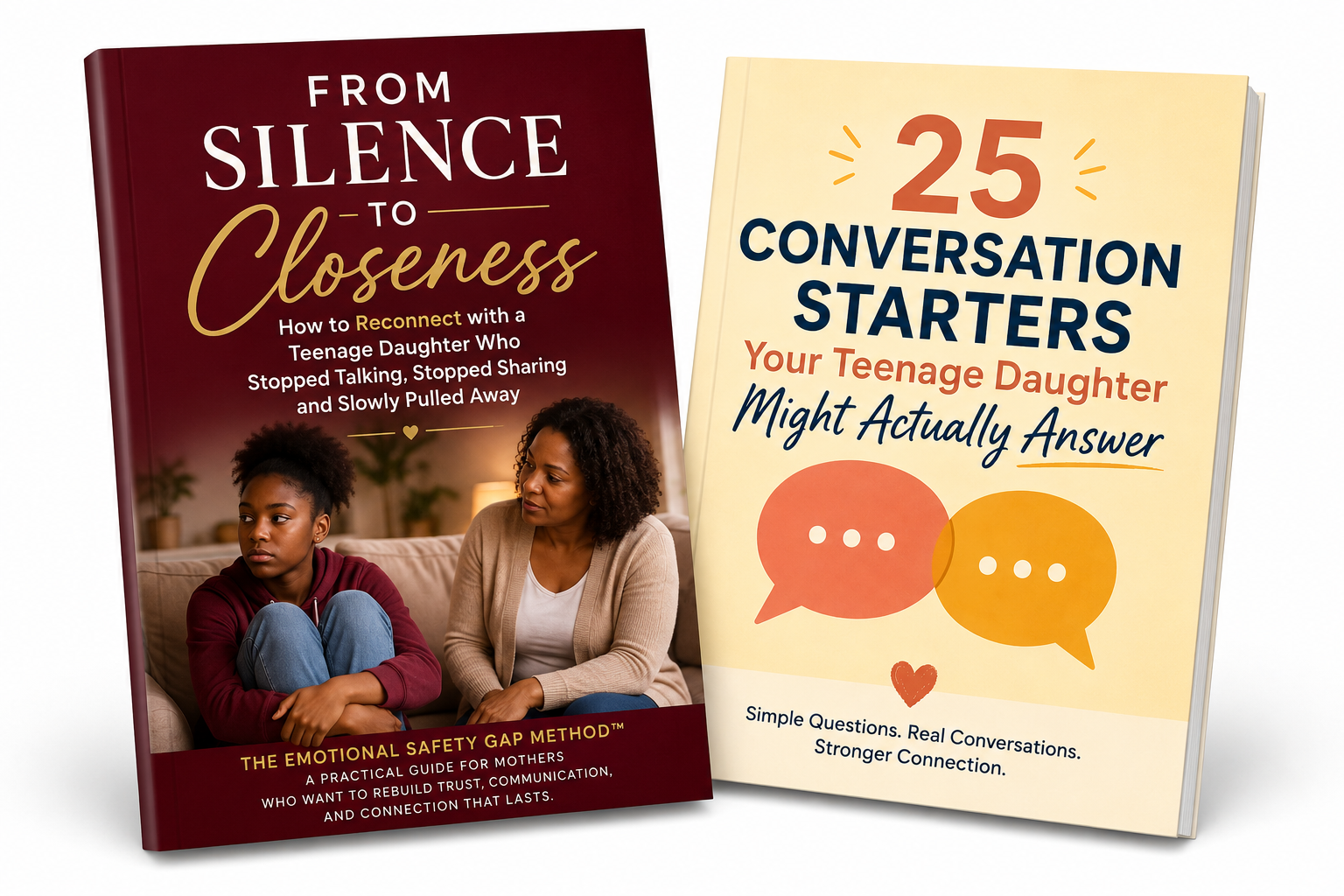
- From Silence to Closeness — Main PDF Guide ₦8,500
- 25 Conversation Starters Your Teenage Daughter Might Actually Answer — Bonus Guide ₦3,500
Right Now, You Have Two Choices
If you do nothing:
- The gap stays. And gets more familiar every day.
- She gets better at being far from you. It becomes her default.
- The Saturday mornings, the evenings, the school runs — they pass. In silence.
- She leaves for university, or life, as someone you once knew well.
- You carry the question forever: What if I had tried something different?
If you take action today:
- You begin closing the Emotional Safety Gap — quietly, from your side.
- Within days, small signs. She chooses proximity. A smile. A question.
- Within two weeks, the temperature in your home changes.
- She comes back. Not because you forced her. Because she feels safe.
- You get her back — before the years are gone.
First 75 women only at this price.
🛡 30-Day Money-Back Guarantee
Follow the Emotional Safety Gap Method as described in the guide for 30 days. If you do the work and you see no shift whatsoever in your relationship with your daughter — contact me and I will refund every kobo. No long arguments. No forms to fill. No embarrassment. You have nothing to lose except the distance.
One Last Thing…
Picture yourself one month from today.
Will you be sitting in the same silence, wondering if today is the day she comes back?
Will you still be watching her laugh freely — with everyone except you?
Will you still be knocking on her door like a guest in your own relationship?
Or will you be the mother standing in the kitchen while her daughter talks — actually talks — for twenty minutes about nothing in particular and everything that matters?
Now picture yourself one month from today if you close this page. Everything stays the same. The silence becomes next month’s silence. The distance becomes next year’s distance. Until one day she is gone — to university, to life, to her own world — and the opportunity to close the gap has simply passed.
The difference between those two versions of you is a decision you make in the next sixty seconds.
I Choose Closeness — ₦6,500If you have read this far and you are still hesitating —
Ask yourself honestly: is it that you do not believe this works? Or is it that somewhere deep down, you do not believe you deserve to have your daughter back?
Because that is what hesitation often really is. Not doubt in the method. Doubt in yourself. Doubt that you are worth the effort. Doubt that it is not too late. Doubt that someone like you — busy, tired, imperfect, human — can actually repair this.
You can. Iya Agba Folasade did not sit on that bench with me because I was a perfect mother. She sat with me because I was a real one.
If you cannot invest ₦6,500 in rebuilding the relationship with your own daughter, what message are you sending yourself about what that relationship is worth?
Your daughter is waiting. She does not know she is waiting. But she is. The door is not locked. It just needs the right signal.
Stop hesitating. Choose yourself. Choose her.
I Am Ready — Get Instant AccessP.S. — This guide comes with a full 30-day money-back guarantee. Follow the method. If you see no shift in your relationship, I will refund you completely. You are not taking a risk. You are taking an action.
P.P.S. — The price of ₦6,500 is only for the first 75 women who pay today. Once those spaces are filled, the price returns to ₦8,500. Do not come back tomorrow and find it has changed.
P.P.P.S. — Every day you wait is another day your daughter practises being far from you. Every day you wait, the gap becomes a little more familiar, a little more normal, a little harder to close. Today is the day to begin.
With love for your healing,
Frequently Asked Questions
How is the guide delivered?
Immediately after your payment is confirmed — usually within 60 to 90 seconds — the guide is sent directly to your WhatsApp number and your email address as a downloadable PDF. You can read it on your phone, tablet, or computer. No waiting. No shipping. Nothing to collect.
Do I need to buy special materials or tools?
No. Everything in the Emotional Safety Gap Method is done with your presence, your words, and your daily routine. There is nothing to buy, nothing to order, no app to download. The guide costs less than a dinner out — and everything else required is already inside you.
My daughter has been distant for more than two years. Is it too late?
It is not too late. The guide includes an Extended Protocol specifically designed for long-term distance — situations where the gap has been in place for two years or more, or where there has been conflict or real hurt between mother and daughter. It takes a little longer than the standard 14-day track. But the method is the same, and the results are the same.
What if my husband or the rest of the household is part of the problem?
The guide addresses this directly. There is a full section on the Household Factor — how the overall emotional environment at home affects your daughter’s safety signals, and what small adjustments support your work without requiring everyone in the house to read a guide or attend a seminar. You do your part. The guide explains how.
Is the 30-day guarantee real?
Completely real. Follow the method as described for 30 days. If you do the work and you see absolutely no shift in your relationship with your daughter — no warmth, no small movement toward you, nothing — contact me directly and I will refund every kobo. No long process. No forms. No embarrassment. I stand behind this fully.
Why is this different from everything else I have tried?
Most parenting advice focuses on what you should say to your daughter. This method focuses on the emotional ground she is standing on when you say it. It does not require her cooperation. It does not require a big conversation or a breakthrough moment. It works quietly, from your side, by changing the signals her emotional brain is receiving. She does not need to know you are doing it. She just begins to feel safer. And when she feels safer, she comes home — to you.
Leave a Comment
type=”email” placeholder=”Your Email (will not be published)” id=”cf-email”>